




When AI Targets the Last Creative Frontier
After conquering text, images, and video, generative AI is now entering a domain long considered untouchable: music. With AudioCraft, its open-source audio generation framework, Meta isn’t releasing a mere experimental tool. The company is deploying an industrial-grade infrastructure capable of automating an increasing portion of sound creation.
Behind the technical feat lies a key question for creators, labels, and investors alike: is the value of music still in its creation, or has it already shifted to distribution and branding?
Meta AudioCraft
AudioCraft: An AI Audio Platform Designed for Industrial Scale
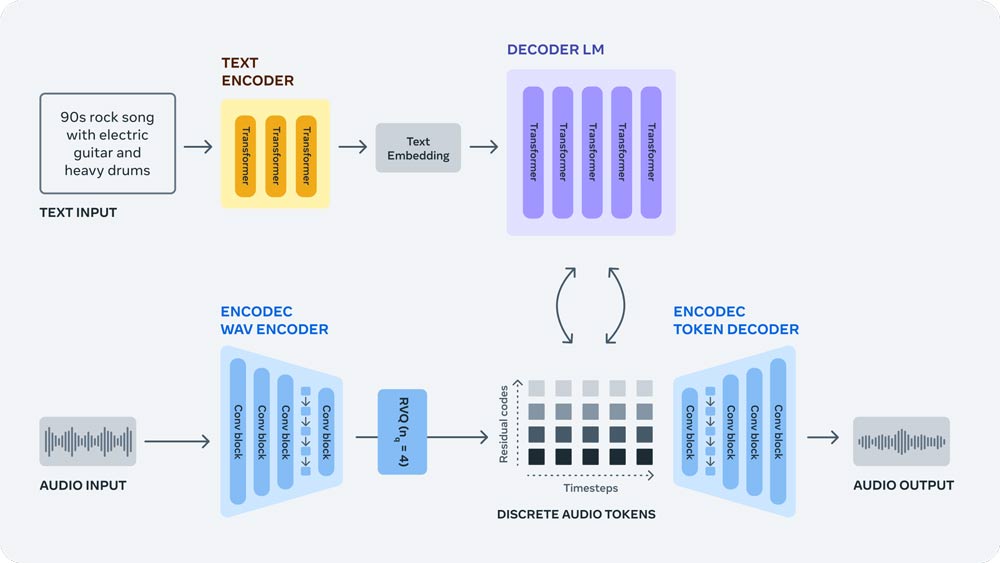
Unlike a single, monolithic model, AudioCraft is a modular ecosystem designed to produce, manipulate, and deliver sound at scale.
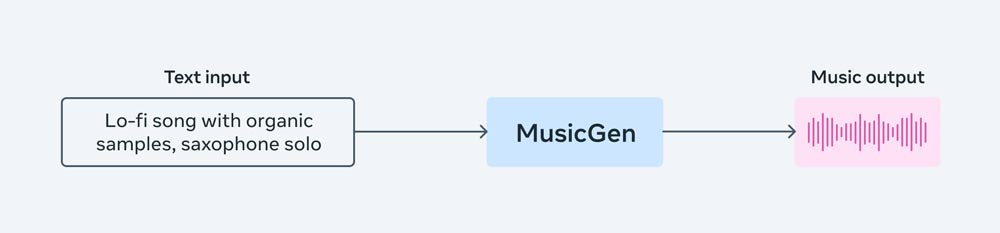
MusicGen – The Music Composition Engine
MusicGen is a Transformer-based model that generates music from:
- a textual prompt (style, tempo, instruments, mood), or
- a reference melody used as a creative guide.
Key point: unlike Google’s MusicLM, MusicGen relies on a single-stage architecture, simpler and faster to deploy in production.
Verifiable data:
- Trained on approximately 20,000 hours of licensed music, according to Meta.
- Datasets include:
- internal music catalogs,
- instrumental tracks from professional libraries like Shutterstock and Pond5 (commercial licenses).
Source: Meta AI research publication, June 2023.
AudioGen – Generating Ambient and Non-Musical Sounds
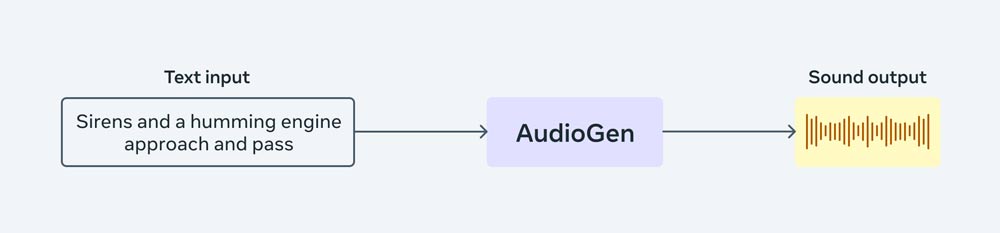
AudioGen focuses on non-musical audio:
- urban noise,
- natural sounds (rain, wind, animals),
- realistic ambiances for video games, films, or the metaverse.
Market significance: according to PwC, the global audio market for gaming and advertising already exceeds $8 billion annually, with strong pressure on production costs.
EnCodec – The Strategic Invisible Layer
EnCodec is Meta’s neural codec for compressing and reconstructing audio while minimizing perceived quality loss.
Strategic roles:
- reduce storage costs,
- enable streaming and editing,
- make real-time audio generation feasible.
Without EnCodec, MusicGen and AudioGen would remain demonstrations. With it, they become industrializable.
Meta vs Google: Two Opposite Approaches to AI Music
Google was first with MusicLM (May 2023). Meta counters with a radically different strategy.
Breaking points:
- Open source: Meta releases code and model weights (MIT and CC BY-NC licenses).
- Accessibility: integration possible by any developer or studio.
- Creative control: melody-guided generation, critical for professionals.
In contrast, MusicLM remains closed, restricted to Google’s internal research.
Strategic reading: Meta isn’t aiming to sell music. It seeks to set a technological standard, much like Android did for mobile.
Legal and Financial Stakes: Systemic Risks Reappear
Copyright: A Persistent Grey Area
Meta claims it uses only licensed data, offering legal protection. Economically, debates continue.
Points of tension:
- lack of individual artist consent,
- inability to trace stylistic influence,
- blurred line between inspiration and replication.
In 2023, Universal Music Group formally requested Spotify and Apple Music to block certain AI-generated content, citing risks of artistic value dilution.
Musical Deepfakes: A Reputational Threat
The most cited example remains “Heart on My Sleeve,” a track imitating Drake and The Weeknd that went viral before being removed.
Main risks:
- brand damage for artists,
- audience confusion,
- loss of control over voice and image.
For major labels, AI is not just a tool—it’s a systemic risk to intangible assets.
Market Analysis: Winners and Losers
Likely winners:
- video game studios
- advertising and branding agencies
- independent creators
- distribution platforms
Medium-term losers:
- stock music composers
- traditional sound libraries
- undifferentiated intermediary professions
Historical parallel: music is following the trajectory of photography after the digital shift. Creation becomes commoditized; value migrates elsewhere.
The Impakt Eye – Special Analysis
AudioCraft doesn’t signal the end of human creativity. It signals the end of technological scarcity in music creation.
Long-term impact is not artistic or moral—it is economic and structural.
Strategic reading: music mirrors the paths of photography and graphic design:
- production becomes abundant, fast, and nearly free
- differentiation shifts from creation to:
- brand,
- audience,
- distribution,
- context of use
AudioCraft accelerates an ongoing shift: functional music (jingles, background scores, stock tracks, short content) is becoming an algorithmic commodity.
5–10 Year Prediction:
- Traditional music libraries will see their value sharply erode.
- Generalist composers will be crushed by near-zero marginal costs.
- Brand-driven artists will see their value rise: concerts, storytelling, identity, community.
- Platforms (streaming, social, gaming) will capture most of the economic rent, controlling access rather than creation.
The real financial bet:
The question is not whether AI will replace musicians. The real question is: who controls technological standards, distribution channels, and direct audience relationships?
Meta isn’t selling music—it is preempting the creative infrastructure of the future. Historically, owners of infrastructure always profit more than content producers.
Strategic Verdict: Redistribution, Not Replacement
MusicGen won’t compose a symphony tomorrow. Limitations are real:
- short tracks (10–20 seconds natively)
- imperfect long-term coherence
- lack of strong artistic intent
But for:
- demos,
- jingles,
- interactive background sounds
productivity gains are already massive.
The key question is no longer creative:
Is music still a product… or already a commodity whose value lies only in distribution?
For investors, the answer will shape the next bets in the creative economy.
FAQ
Sources & References
- Meta AI — Simple and Controllable Music Generation (2023), arXiv: https://arxiv.org/abs/2306.05284
- TechCrunch — Meta open-sources AudioCraft and MusicGen: https://techcrunch.com/2023/06/12/meta-open-sources-an-ai-powered-music-generator/
- Digital Music News — How Meta Trained MusicGen: https://www.digitalmusicnews.com/2023/06/12/meta-releases-ai-music-generator-musicgen-how-it-works/
- PwC — Global Entertainment & Media Outlook: https://www.pwc.com/gx/en/industries/tmt/media/outlook.html