


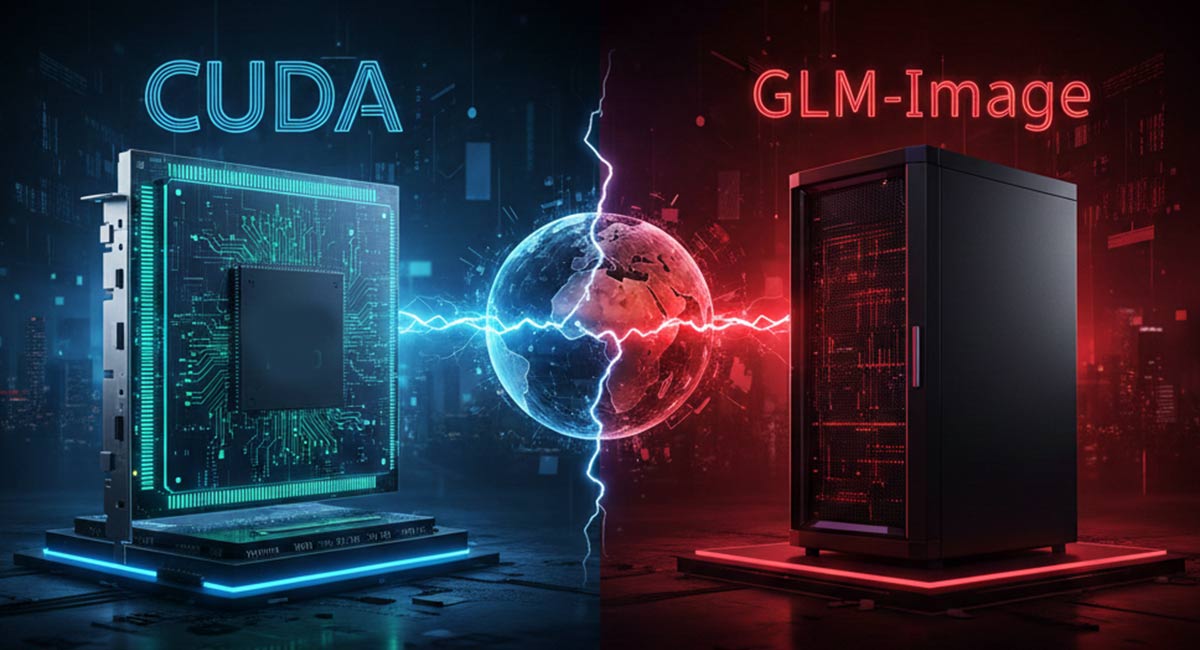
For years, Nvidia has been the invisible backbone of global artificial intelligence. GPUs, CUDA, software ecosystem: an effective near-monopoly.
Since 2023, however, a quiet shift has been underway. Faced with U.S. sanctions, China did not slow down. It circumvented, replaced, and internalized.
With GLM-Image, trained exclusively on Huawei Ascend hardware, the startup Z.ai (formerly Zhipu AI) does not mark the fall of Nvidia. It signals something more significant: the end of Nvidia’s universality.
Key Data Points: China’s Tech Offensive
An AI model trained without Nvidia or U.S. infrastructure
GLM-Image is among the first image-generation models trained on a 100% Chinese tech stack:
- Hardware: Huawei Ascend Atlas 800T A2, Kunpeng processors
- Software: MindSpore framework (Huawei), local alternatives to CUDA and PyTorch
- Cloud & Data: domestic infrastructures, excluding U.S. hyperscalers
👉 This is verifiable via Zhipu AI technical reports and Huawei announcements from 2025–2026.
Performance and Market Positioning
GLM-Image is not a general-purpose giant model. Its strength lies elsewhere.
- Model size: ~16 billion parameters
- Architecture: hybrid, optimized for vision and structured text
- Benchmark CVTG-2K: reported score 0.9116
- Use case: specialized in multilingual text-to-image rendering
- Less recognized than COCO or ImageNet, but widely used in China’s open-source ecosystem
➡️ Honest conclusion: excellent on targeted tasks, not a direct competitor to GPT-4 or Western high-end diffusion models.
Costs and Economics: Where the Chinese Model Becomes Dangerous
A different cost-performance equation
According to Chinese industry analyses (CAICT, Huawei Cloud), local training on Ascend enables:
- Estimated cost reduction of 30–40%
- No CUDA licensing fees
- Lower energy consumption
- Local industrial subsidies
⚠️ These figures are indicative, not internationally audited standards, but align with CAPEX gaps observed between U.S. and Chinese infrastructures.
Growth and Funding of Z.ai
- Estimated CAGR (2022–2024): >100%
- Total funding: ~$560 million
- Stated goal: IPO preparation in Hong Kong (not yet officially filed with HKEX)
👉 Data sourced from Reuters, Network World, and Chinese investor communications. Timelines remain uncertain.
Huawei Ascend: A Regional Alternative, Not a Global Replacement
What Huawei does better than Nvidia
- Fully vertical integration (chip, server, cloud, framework)
- Total technological sovereignty
- Massive deployment in Chinese enterprises and government
What Nvidia still controls
- Global software ecosystem (native CUDA, PyTorch)
- Superior raw performance, energy efficiency per computation, scalability
- Decisive advantage outside China—particularly in the U.S., Europe, and Japan
➡️ This is not a global replacement; it is a regional technological decoupling.
Historical Insight: When Sanctions Accelerate Autonomy
Industrial history is clear:
- Oil embargoes accelerated nuclear development
- Semiconductor restrictions accelerated Asian fabs
U.S. sanctions on Nvidia GPUs had a paradoxical effect:
👉 They turned China’s dependency into a strategic industrial priority.
Nvidia: A Monopoly Cracking, Not Collapsing
Market reality
- Nvidia remains dominant in the global AI GPU market
- China represented 20–25% of long-term growth potential before restrictions
- This segment is now structurally constrained
➡️ The risk for Nvidia is not comparative performance loss but losing an entire market that has become self-sufficient.
The Impakt Eye — Special Analysis
Let’s not mistake the real challenge.
This is not about “Nvidia falling.” It is worse for the West and subtler for markets: the end of universal AI built on a single tech stack.
Long-term financial impact:
- Nvidia will remain dominant in premium markets (U.S., Europe, hyperscalers, cutting-edge AI).
- But Nvidia will no longer be indispensable everywhere, fragmenting its value.
China is building a competitor not on peak performance, but on:
- Technological sovereignty
- Total cost of ownership
- Capacity for mass deployment in non-aligned countries
This mirrors how Huawei survived telecom sanctions. History is repeating, now in AI.
Bold (Yet Rational) Prediction
By 2028–2030, the global AI market will be bipolar:
- Nvidia-centric bloc: ultra-performance, high-cost, regulated
- Huawei/China-centric bloc: lower performance, widespread in Asia, Africa, Middle East, and Latin America
👉 For investors, the real risk is not a Nvidia crash.
👉 The real risk is a silent erosion of its global addressable market.
Once an alternative software ecosystem matures, reversal becomes almost impossible.
Conclusion: Towards Multipolar AI
GLM-Image does not bury Nvidia.
It signals something deeper: AI will no longer rely on a single global infrastructure.
Two blocs are emerging:
- Maximum performance + global ecosystem (Nvidia, U.S., allies)
- Sovereignty + controlled costs (Huawei, China, Global South)
At what point do cost, sovereignty, and accessibility outweigh raw performance?